Albin Vega: the fiberglass boat that became Sweden’s people’s boat
From Per Brohäll’s commission in 1964 to the museum boat TERTIA: Albin Vega became one of the great Swedish family cruisers of the 1960s and remains a popular classic.
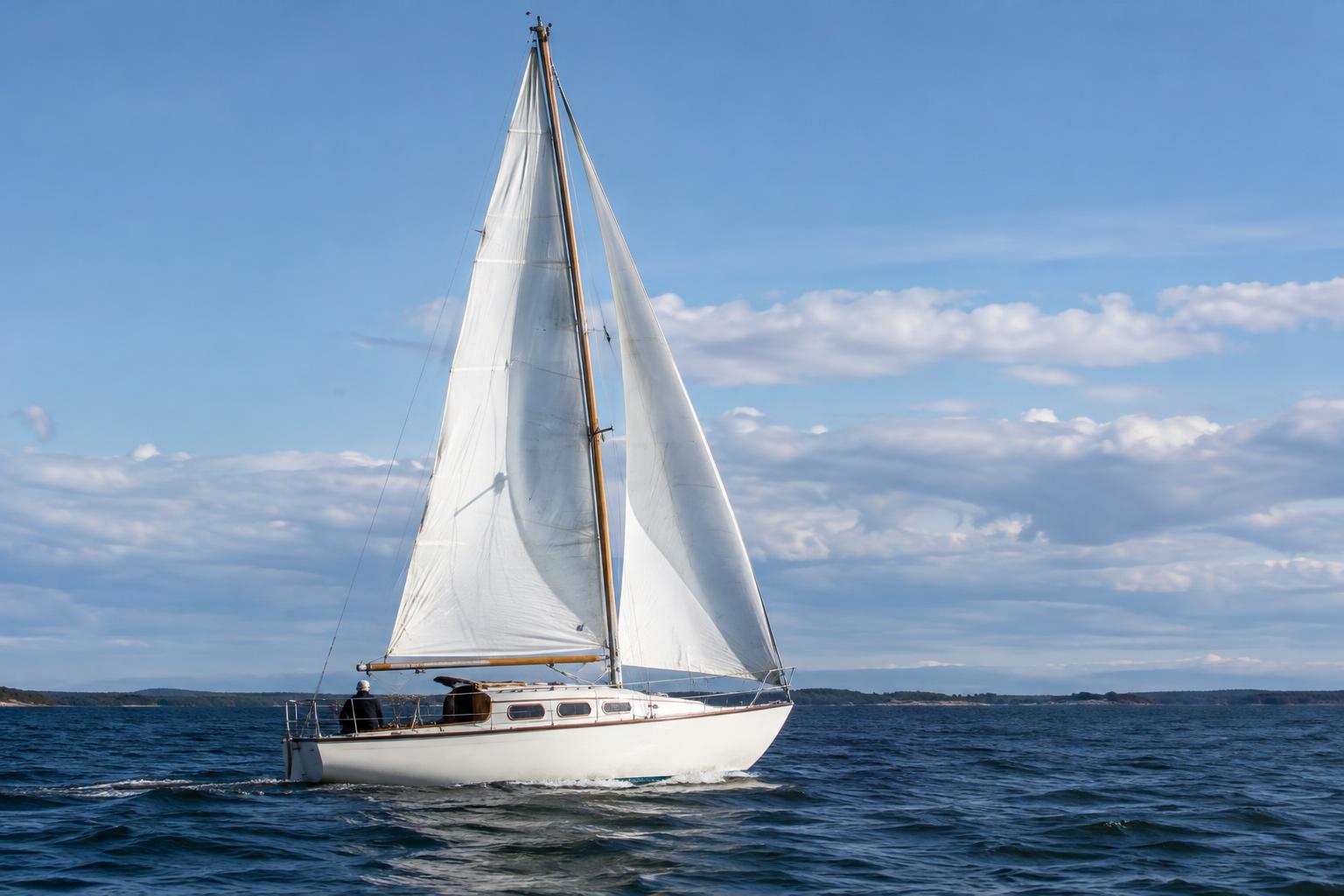
From idea to people’s boat
When Albin Vega took shape, the idea was clear: a mass-produced family boat in fiberglass that could be built efficiently, sold directly to customers and suit a new era in Swedish boating. The commission was given to Per Brohäll in 1964. The first wooden prototype was launched the following year, and production then moved to glass-reinforced plastic at Albin Marin in Kristinehamn.
It was a time when the yard was seeking greater control over both design and sales. Vega was not just another sailboat in the catalogue, but a model that carried much of Albin Marin’s larger investment throughout the 1960s and 1970s: standardised production, efficient manufacturing and a family boat intended to reach far beyond the traditional racing-sailing audience.
The technology behind the model
Vega was built as a one-design boat in fiberglass and quickly gained a reputation for being stable, well-sailing and spacious. The source material also describes her as an all-weather boat, with good sailing qualities in both light breezes and fresher winds. This is an important part of the explanation for why the model took off well beyond the small circle usually attracted to new plastic designs.
The construction consisted of glass-reinforced polyester, a hardwood and veneered plywood interior, and an anodised aluminium mast and boom. The propeller could feather under sail, and under power the boat was reported to make 6.5 knots. Changes were also made during production: in the late 1970s, alterations to the interior and a wider coaming are noted, resulting in a slightly greater weight, more ballast and a draught that increased from 1.17 to 1.20 metres.
The production figures show the model’s impact, although the source material gives two different totals: the Maritime Museum’s figure is 3,400 boats between 1966 and 1980, while the Albin Vega Directory gives 3,450 boats when production ended in 1979. Whatever the exact final figure, the numbers are enough to place Vega among the genuine bestsellers in the history of Swedish recreational boating.
TERTIA: the original that still tells its story
What makes the model especially vivid today is that a few examples have carried its history almost unchanged through the decades. TERTIA, sail number S 211, was bought by Åke Boman directly from Albin Marin in Kristinehamn in 1968. The owner’s family then sailed the boat from her home port of Västerås until the Maritime Museum took her over in 1996.
The museum boat has been changed very little from her original condition. That makes her more than a preserved hull; she shows how Vega was actually intended to be used and experienced. The fact that the original engine, an Albin O-21, is still aboard further enhances her historic value. Here, not only the form has been preserved, but also the technical whole that made the model relevant to its time.
The family classic that never disappeared
Vega became a people’s boat in the sense Swedish sailors often give the term: a boat many could own, use and recognise. She was spacious enough for family life, stable enough for reassuring sailing and produced in sufficient numbers to become a familiar sight at quaysides throughout Sweden and in harbours across the Nordic countries.
The fact that the model is still described as a very popular family boat says something about the staying power of the original idea. Vega was not just an answer to the 1960s’ optimism about plastic boats. She also became one of the clearest examples of how a straightforward, well-balanced family cruiser could enjoy a long life after series production had ended.
More in People & History
ExploMar showcases 400 hp concept in Amsterdam
The Shanghai-based electric propulsion specialist offers a first look at an upcoming 400 hp outboard at Metstrade and highlights the step from 100 to 300 hp in its current range.
How it is decided which antifouling paint can be used
The right paint depends on where the boat is moored, what type of paint it is and whether the product is approved. In the Bothnian Bay and inland waters, no biocidal paints are approved.

Joshua Slocum and Spray: Alone Around the World
When Joshua Slocum left East Boston aboard the rebuilt Spray in 1895, many thought the venture was foolish. Thirty-eight months later, he was the first person to have sailed alone around the world.